Shadle
San Diego Writers Festival
​

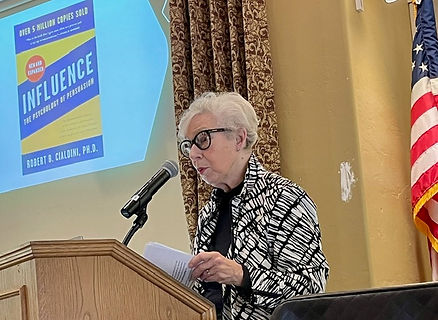
The San Diego Writers Festival in Coronado, CA, on April 5, 2025, was an unforgettable event featuring over 100 inspiring speakers. The wealth of knowledge and creativity shared was both stimulating and invigorating. I was thrilled to be there.
BOOK LAUNCH
In February, 2025 I LAUNCHED THE BOOK at the La Jolla Riford Public Library, formally introducing my book and celebrating the value of memoir writing. Several dozen friends and neighbors came to learn about the book and offer their reflections. Many resonated with the doubts disclosed in my writing. Older readers connected with the events of the last eight decades which influenced my thinking. It was a wonderful opportunity to share the evolution of thoughts and beliefs as well as the wonders of writing, especially memoir writing.
After diving into the pages of the book, we came together to share thoughts and insights, while enjoying delicious cake and refreshing lemonade. It was a delightful way to connect over our shared love for reading and writing.


BOOK REVIEWS
I have learned that authors seek reviews. They offer good feedback for the author, and also alert readers to book worth reading.
​
I would welcome your review on Amazon. Click the link to take you to the Amazon review page. Amazon Reviews
Kirkus Reviews are considered notoriously honest and harsh. Given that reputation, I was honored to receive their following review:
In Shadle's account, her journey from the Christianity of her parents and upbringing to her current beliefs began in earnest in 2011 when, visiting the Louvre, she first encountered the stele containing the Code of Hammurabi, dating from the 18th century B.C.E.—at least 300 years before Moses and his Ten Commandments. "That," she reflects, "was when I first doubted what I'd been taught about the infallibility of the scriptures”…. As the author's reading and thinking broadened, and as she had more experiences like the one with the Code of Hammurabi, she began to question the existence of God. "I determined my beliefs based on reason, not on faith," she writes, concluding that reason and science have reduced more human suffering than any religion…. Shadle writes with a brisk energy that makes for smooth reading, and her narrative is given a good deal of extra texture by her frequent quotes from and allusions to the many books she's read, including fundamental texts like John Dominic Crossan's The Historical Jesus and Walter Sinnott-Armstrong's Morality Without God…. Virtually any erstwhile believer who has left Christianity behind will find some aspect of their own experience relatably recounted in these pages….
​
​
I appreciate this review from Wisconsin Bookwatch:
Informative, insightful, candid, thoughtful and thought-provoking, "From Religion to Reason: My Journey" is an extraordinary and emotionally engaging read from start to finish. A deftly crafted and intensely personal life story with universal resonance and relevance for readers with an interest in Religious Fundamentalism and the role of Critical Thinking, Rationalism, and Faith. [The book is] unreservedly recommended for personal, professional, community, and college/university library Contemporary American Biography/Memoir collections.
​
I’d like to share with you excerpts of two reviews I received from Online Book Club:
By Kutlioana Makhuvhal
Nowadays, it is either you are a believer or an atheist. Not that you are forced to be either, but you can tell that almost everyone is curious and expects you to pick a label and stick to it….The author wrote it all in a tone that was as calm as the river in its middle stage. I loved the most how the author wasn’t preachy in everything she talked about. She was not lecturing either. She just told it as it was and how it affected her at the time….
The author took us on a journey to show us that there was more to the spectrum than we thought there was. One word to describe the feeling I got while reading the book would be ‘relaxed’. Reading the title of the book, it is easier to think you know where the author will end up, but that is not the case….
​
It sounds like a refreshing and open-minded take on personal growth and belief, without the usual pressure to pick a side. The relaxed, honest storytelling makes it even more appealing….
​
​
Add YOUR CUSTOMER REVIEW on Amazon. Go to Amazon.com, select From Religion to Reason, go to the bottom of that page and add your comments under CUSTOMER REVIEWS - short or long, your name or a false name.
Freethought Society Newsletter, May, 2025Ezine@FtSociety.orgReview of Dr. Carolyn C. Shadle’sFrom Religion to Reason: My Journeyby David MadisonOne of the surprising developments of our time— or maybe it’s not so surprising — is the marked increase of people who admit that they have no religious affiliation. They have been labeled as the “nones.” One factor might be thatsome churchgoers decided to read the Bible and discovered just how flawed it is, that it falls far short of being a divinely inspired book. Or they’ve been fooled by the clergy. Another factor is increased scientific understanding of the world and how it works. In Western Europe, after two world wars that killed up to ninety million people, belief in god has declined sharply. Surely Christianity is also taking a hit because one of the least religious, least moral persons on the planet has been championed by fanatical Christians — and this week has returned to the White House. That will certainly cause substantial damage to the faith in the longrun. Of course, the process of “leaving God behind” varies greatly from person to person, and I’ve always been drawn to books written by those who have managed to escape the faith, whether it was sudden or gradual. I have finished reading Dr. Carolyn C. Shadle’s excellent book, From Religion to Reason: My Journey. Shadle was raised in a conservative Christian home in Washington, D.C. Naturally she accepted what she was taughtabout the Bible, God, and Jesus. But over the years reality poked holes in her religious assumptions:“My earliest memories of Sunday School are pleasant ones. I felt safe and comfortable in the all-White congregation. I never doubted what I was told aboutthe church. It was much later when Martin Luther King pointed out that the most segregated hour in America was at eleven o’clock on Sunday morning.Until then, I had experienced the world as White. I was oblivious to how segregated our churches were. Later, this emerged as a factor in my young adulthood, questioning my ongoing affiliation with the church and religion.”It was during her junior year of college, when she studiedabroad in Switzerland, that her horizons expanded dramatically:“Looking back, I can see how that year of study impacted my beliefs. The readings required in the Church History course made me aware of the variety of theologies. This included Martin Luther’s opposition to the Roman Catholic Church and then the scores of break-away groups that formed new denominations within the Protestant movement.”“My study of Calvin’s theocracy gave me better insight into the roots of Presbyterian doctrine and how eager a religious group can be to impose its theology on others. This study prepared me to understand current efforts by the Religious Right that sound a lot like the Calvinist movement. Probably the major effect of my year in Europe was to soften the way I saw the world. The harsh black-and-white absolutist thinking beg to fade.”Since my own belief in God evaporated while I was in seminary, I can sympathize with Shadle’s experience at Union Theological Seminary in New York. She wrote:“My disposition leaned more toward the cerebral, leaving my feelings detachedfrom religious rituals. This experience marked my initial awareness that prayer had always been meaningless to me.”“Over time, there was a growing sense that God didn’t hear me or appeared to be indifferent to my supplications… I do remember praying privately as avery young child, but I confess that I had no sense of a response. Despite my profound regard for the church and my study of the Bible and theology, I thinkI became uninterested in God. Maybe the ‘God up there’ didn’t really exist, I thought. Maybe life ‘downhere’ was the real thing.”Despite this startling realization, Shadle still saw value in what she considered Christian values, namely being compassionate and caring, and wanting to help others improve their lives. Describing the ups and downs she faced, Shadleforged a successful career implementing her convictions. She also married and had two daughters. Her book is an engaging, highly readable description of the ways in which these events unfolded, including, eventually, her divorce.As her life continued to unfold, the god-factor was reduced more and more. In her final chapter: “At Last, An Identity.” She states:“I’m not surprised that so many are unaffiliated with a religious group given improved scientific understanding, a better understanding of history, new developments in exegetical techniques for understanding biblical writings, changing social norms, and an increasingly pluralistic religious culture with more freedom to doubt and question. I believe that the Enlightenment, science, and the notion of liberty have been more responsible for human progress than religion. In fact, given all these factors, I wonder why so many people are NOT a ‘none.’”And the day came when atheist seemed like the right designation for herself:“One day I saw an atheist in the mirror. I felt that it was more honest and clear-cut to admit that my belief led me to call myself an atheist. I finally excoriatedsilence.”As for this book reviewer, by the time I had finished my PhD in Biblical Studies (1975) — and served for nine years as pastor of two Methodist parishes — I realized that belief in God was delusional. All of the strained apologetics I witnessed in seminary were a major clue that the foundations of theology could not be sustained. I left the ministry, gave up my ordination, and eventually landed in a business career. The last fifteen years, before my retirement in 2014, I was thedirector of an association of career coaches. It was gratifying indeed to be in a helping profession. During her long career, Shadle kept her focus on helpingpeople. She got a PhD in interpersonal communication from the State University of New York in Buffalo, which proved far more helpful than my doctorate in Biblical Studies! And she has identified the huge danger that Christianity nowposes:“As I have rethought my religious faith, I’ve grown to appreciate and respect the diverse religious traditions as well as the right to hold no belief at all.Consequently, I see Christian nationalism as a perilous initiative, defining who belongs to this nation and who does not, whose religion holds significance,and whose does not…. I think the movement now is acting out of fear based on the steep decline in the number of Americans who identify themselves as Christian.”Shadle belongs to and supports the Freedom from Religion Foundation, whose co-presidents are Annie Laurie Gaylor and Dan Barker. They recently interviewed her on their Freethought Radio Program. Below is the link. Shadle is introduced at the 23:25 mark:https://ffrf.org/news/freethought-radio/freethought-today- January-16-2025/From Religion to Reason: My Journey is indeed an important addition to the growing library of books written by humanists, secularists, and atheists. Shadle is living proof that nones can be highly productive, compassionate, and moralcontributors to our society. We can think of this book as a love letter to churchgoers who may suspect that something is not right and a testimony to the high moral standards of many nonbelievers.From Religion to Reason: My Journey:https://www.amazon.com/Religion-Reason-My-Journey/dp/B0DQV4PHQNFor those who prefer to support independent booksellers, this list is a great resource: https://en.wikipedia.org/wiki/List of independent_bookstores_in_the_United_StatesBook reviewer David Madison was a pastor in the Methodist Church for nine years. After graduating from Indiana University, he moved on to graduate school in Boston. But seminary studies, which included mind-numbing courses in theology, proved to have a corrosive effect on his faith. This process of faithdisintegration continued even as he served as a pastor. Madison eventually made his escape from the church and pursued a business career. His fascination with Biblical studies, however, did not diminish, especially since the Bible is a self-incriminating document! He pursued theological reading and marveled that serious thinkers could take the Bible seriously.He is the author of three books, Guessing About God, Ten Things Christians Wish Jesus Hadn't Taught: And Other Reasons to Question His Words, and Everything You Need to Know About Prayer But May Not Want to Admit (Ten Tough Problems in Christian Belief).
Excerpt from review by Consuelo de HolguÃn of La Paz, Mexico Among the highlights of her story are those in which the author points out the extreme degree of moral pressure that society exerts on each one of its members, especially children, through moralistic pacts carried out during religious ceremonies. The coercion is such that it condemns virtually all listeners to carry it for life. Not even a first-rate academic education seems to have the power to free human beings from what they believe and feel they are obligated to revere as sacred and blindly obey, considering it a divine mandate.… Carolyn achieves this thanks to her extraordinary capacity for reasoning, free from all submission to social conventions and atavisms such as superstition. Added to all this is her equally extraordinary willingness to love. These are the ingredients that empower her to rise above her alienated social context and, therefore, her time.